
Há algo profundamente satisfatório em colocar uma bomba de banho na água morna e vê-la girar, efervescer e libertar redemoinhos de cor. Agora imagine que o seu filho fez essa bomba de banho sozinho. O orgulho no rosto dele? Incomparável. Fazer bombas de banho em casa é uma daquelas atividades raras que realmente entretêm crianças de uma ampla faixa etária, ao mesmo tempo que introduzem um pouco de ciência, um pouco de arte e muita diversão sensorial.
Já fiz este projeto com os meus próprios filhos mais vezes do que consigo contar e, sinceramente, nunca perde a graça. A receita é flexível, os ingredientes são baratos e a limpeza é controlável — na maior parte. Aqui está tudo o que precisa de saber para fazer isto com sucesso.
Porque Fazer Bombas de Banho É uma Excelente Atividade para Crianças
Na sua essência, uma bomba de banho é uma experiência simples de química. Quando o ácido cítrico e o bicarbonato de sódio entram em contacto com a água, reagem para produzir dióxido de carbono — aquelas bolhas satisfatórias que vê. Explicar isto a uma criança de seis anos em termos simples ("os dois pós são amigos que ficam entusiasmados quando tocam na água") faz com que ela se sinta uma verdadeira cientista.
Para além da ciência, esta atividade desenvolve a motricidade fina. Medir, recolher, pressionar a mistura em moldes — tudo isso exige coordenação manual e paciência. As crianças mais pequenas (cerca dos 3-4 anos) podem ajudar a mexer e a pressionar. As crianças mais velhas podem tratar da medição e da mistura de forma independente. Os adolescentes podem interessar-se pela vertente de design criativo, experimentando padrões de cor e combinações de aromas.
Também é, simplesmente, uma experiência sensorial verdadeiramente divertida. As texturas mudam à medida que mistura. Os aromas enchem a divisão. E a expectativa de esperar que sequem antes de as testar? Isso ensina gratificação adiada de uma forma que não parece uma lição.
O Que Vai Precisar — Análise de Ingredientes Adequados para Crianças
Os Ingredientes Base
Só precisa de quatro ingredientes base, e nenhum deles é exótico:
- Bicarbonato de sódio — a base da sua bomba de banho. Um saco grande de qualquer mercearia custa alguns dólares.
- Ácido cítrico — disponível na secção de conservas das mercearias ou online. Um saco de 2-pound custa normalmente $8-12 e dura muitas fornadas.
- Amido de milho — atua como um agente de enchimento que suaviza a mistura e abranda a reação efervescente para que dure mais tempo na banheira.
- Sal de Epsom — opcional, mas agradável. Acrescenta um elemento calmante e confere à bomba de banho uma textura ligeiramente mais granulada que se mantém bem unida.
Todos estes se qualificam como ingredientes adequados para crianças. Nada aqui é tóxico, embora o ácido cítrico possa arder se entrar em contacto com os olhos ou cortes — mais sobre segurança mais adiante.
A Parte Divertida
É aqui que as crianças realmente se envolvem. Para cor, o pó de mica proporciona resultados vibrantes e seguros para a pele, sem manchar a banheira. O corante alimentar também funciona, mas use-o com moderação — em excesso pode tingir temporariamente a pele e a porcelana.
Quanto ao aroma, escolher óleos essenciais para crianças exige algum cuidado. Lavanda e laranja-doce são geralmente considerados seguros para crianças com mais de 2 anos quando devidamente diluídos. Tea tree, eucalipto e hortelã-pimenta devem ser evitados em crianças pequenas. Se n'ao tiver a certeza, ignore completamente os óleos essenciais — a bomba de banho continuará a efervescer lindamente sem eles.
Complementos divertidos tornam cada bomba de banho única: pétalas de flores secas (calêndula e lavanda funcionam bem), purpurina biodegradável ou pequenas surpresas de brinquedo impermeáveis pressionadas no centro. As crianças adoram a ideia de um tesouro escondido no interior.
Ferramentas e Moldes
N'ao precisa de equipamento especializado. Moldes de silicone da secção de pastelaria funcionam na perfeição — pense em formas de muffins, estrelas, corações. Metades de enfeites de plástico (do tipo bola de Natal transparente) criam bombas de banho redondas clássicas. Até formas de muffins forradas com película aderente servem numa emergência.
Outras ferramentas úteis: um frasco pulverizador cheio de álcool isopropílico ou hamamélis, taças de mistura, copos medidores e luvas descartáveis se os seus filhos tiverem pele sensível.
Receita Passo a Passo de Bomba de Banho (Versão Adequada para Crianças)
Proporções Básicas da Receita
A proporção áurea para bombas de banho efervescentes é 2 partes de bicarbonato de sódio para 1 parte de ácido cítrico. Tudo o resto é flexível. Aqui está um bom lote inicial:
- 1 chávena de bicarbonato de sódio
- 1/2 chávena de ácido cítrico
- 1/2 chávena de amido de milho
- 1/4 chávena de sal de Epsom
- 2-3 colheres de sopa de óleo de coco ou óleo de amêndoas (derretido)
- Algumas gotas de óleo essencial (opcional)
- Corante à escolha
Isto rende aproximadamente 4-6 bombas de banho, dependendo do tamanho do molde.
Instruções de mistura
A ordem é importante aqui. Combine sempre primeiro os ingredientes secos — bicarbonato de sódio, ácido cítrico, amido de milho e sal de Epsom. Misture-os bem com um batedor. Quaisquer grumos agora significam efervescência desigual mais tarde.
Numa pequena tigela à parte, misture o óleo de coco derretido, os óleos essenciais e o corante. Depois, verta lentamente a mistura líquida na mistura seca, mexendo constantemente. Esta é uma ótima tarefa para as crianças — uma deita enquanto a outra mexe. Vá devagar. Se adicionar o líquido demasiado depressa, irá desencadear prematuramente a reação de efervescência e acabará com uma bomba de banho sem efeito.
A mistura está pronta quando se mantém unida como areia húmida ao ser apertada. Se estiver demasiado esfarelada, borrife ligeiramente com o frasco pulverizador — uma pulverização de cada vez.
Moldagem e Secagem
Comprima a mistura firmemente nos moldes. Pressione bem. A compactação insuficiente é a principal razão pela qual as bombas de banho se desfazem. Se utilizar moldes esféricos de duas partes, encha ligeiramente em excesso cada metade e, em seguida, una-as pressionando e rode suavemente.
Deixe-as secar durante pelo menos 24 horas num local fresco e seco. A humidade é o inimigo aqui — se vive num local húmido, considere secá-las perto de um desumidificador ou numa divisão com ar condicionado. Devem estar completamente sólidas antes de as desenformar.
Dicas de Segurança que os Pais Devem Conhecer
As bombas de banho são geralmente seguras, mas algumas precauções tornam a experiência melhor para todos:
- Faça primeiro um teste de contacto. Antes de o seu filho tomar banho com uma bomba de banho caseira, dissolva um pequeno pedaço em água e peça-lhe que mergulhe uma mão durante um minuto. Observe se há vermelhidão ou irritação.
- O ácido cítrico provoca ardor. Não é perigoso, mas se uma criança pequena esfregar os olhos depois de o manusear, haverá lágrimas. As luvas ajudam, e lavar as mãos entre etapas é uma medida sensata.
- A diluição dos óleos essenciais é importante. Para crianças dos 2 aos 6 anos, mantenha os óleos essenciais numa diluição de 0.25-0.5% (aproximadamente 1-2 gotas por lote). Crianças dos 6 aos 12 anos podem tolerar até 1%. Em caso de dúvida, não os utilize.
- Supervisione o banho. Lembre as crianças de não colocarem pedaços efervescentes da bomba de banho diretamente na pele ou perto do rosto. A reação de CO2 é inofensiva, mas a concentração de ácido cítrico antes de se dissolver completamente pode causar irritação.
- Evite totalmente os óleos essenciais para bebés e crianças com menos de 2 anos.
Resolução de Problemas Comuns
Bombas de banho a desfazerem-se: Não há humidade ou óleo suficientes, ou não compactou com firmeza suficiente. Da próxima vez, adicione um pouco mais de óleo e comprima bem a mistura nos moldes.
A expandir ou a rachar no molde: Foi adicionado líquido em excesso, o que desencadeou uma reação lenta. O gás CO2 expande-se dentro do molde. Da próxima vez, adicione os ingredientes húmidos de forma mais gradual.
Não faz efervescência suficiente: O seu ácido cítrico pode estar antigo, ou a proporção pode estar incorreta. Certifique-se de que mantém a proporção de 2:1 entre bicarbonato de sódio e ácido cítrico. O ácido cítrico fresco faz uma diferença notória.
A manchar a banheira: Normalmente é um problema com o corante alimentar. Opte por pó de mica ou reduza o corante alimentar para um máximo de 1-2 gotas. Enxaguar rapidamente a banheira imediatamente após a drenagem evita a maioria das manchas.
Variações Criativas para Experimentar
Bombas de Banho Galaxy
Divida a sua mistura em três porções. Dê-lhes cor roxo escuro, azul-marinho e preto. Coloque-as em camadas soltas no molde sem misturar completamente — o objetivo é obter veios, não uma cor uniforme. Adicione brilho iridescente fino para um efeito de céu estrelado.
Bombas de Banho com Cor Oculta
Faça a camada exterior branca ou em tom claro, mas pressione uma bola concentrada de mistura de cor viva no centro. Quando fizer efervescência na banheira, começa branca e depois explode numa cor inesperada. As crianças adoram absolutamente esta opção.
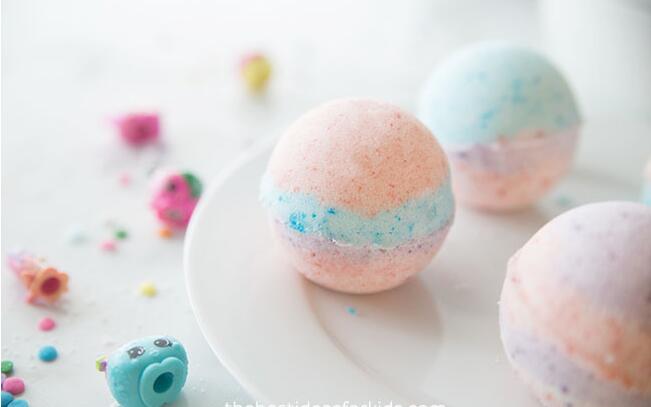
Bombas de Banho Arco-Íris em Camadas
Pressione camadas finas de cores diferentes no molde, uma de cada vez. Vermelho, laranja, amarelo, verde, azul, roxo — cada camada compactada suavemente antes de adicionar a seguinte. A efervescência revela faixas de cor na água.
Bombas de banho como projetos de presentes DIY
As bombas de banho caseiras são presentes genuinamente atenciosos. Embrulhe-as em papel de seda ou sacos de celofane com uma fita. Funcionam lindamente como lembranças de festa, presentes para professores ou presentes de Natal. Isto transforma as atividades DIY de banho em algo que as crianças podem partilhar com pessoas de quem gostam — o que acrescenta uma camada totalmente nova de significado ao projeto.
Considerações finais
Sim, haverá pó no seu balcão. Provavelmente também algum no chão. Talvez uma impressão de mão colorida em algo que não deveria ter uma impressão de mão colorida. Mas a questão de fazer bombas de banho com crianças é que esta atividade atinge o equilíbrio perfeito entre projeto criativo e experiência científica que muito poucas atividades conseguem alcançar.
A minha sugestão: não procure a perfeição no primeiro lote. Deixe que seja algo desorganizado e experimental. Deixe os seus filhos escolherem combinações de cores estranhas e quantidades de brilhantes duvidosas. As bombas de banho não precisam de ser dignas do Instagram para serem divertidas. Torne isto numa atividade regular — uma atividade para um sábado chuvoso, uma estação numa festa de aniversário, uma tradição de Natal. A receita é suficientemente simples para que, depois de uma ou duas vezes, os seus filhos estejam a ensinar os amigos a fazê-la.
Perguntas frequentes
Com que idade as crianças podem começar a fazer bombas de banho?
Com supervisão direta, crianças a partir dos 3 anos podem participar a mexer e a pressionar a mistura nos moldes. Aos 6-7 anos, a maioria das crianças consegue lidar com a medição e a mistura com ajuda mínima. A atividade adapta-se bem — basta ajustar quais os passos que fazem de forma independente.
As bombas de banho são seguras para crianças pequenas usarem na banheira?
De um modo geral, sim, desde que evite óleos essenciais e utilize o mínimo de corante. Esteja atento a qualquer reação cutânea e mantenha o banho curto (menos de 15 minutos). Evite bombas de banho com pequenos brinquedos no interior para crianças com menos de 3 anos devido ao risco de asfixia.
Posso dispensar o ácido cítrico e usar outra coisa?
O cremor tártaro funciona como substituto, embora a efervescência seja mais fraca e o custo mais elevado. Algumas receitas utilizam pó de sumo de limão. Nada produz exatamente a mesma reação vigorosa que o ácido cítrico e o bicarbonato de sódio juntos, mas existem alternativas se o ácido cítrico não estiver acessível.
Quanto tempo duram as bombas de banho caseiras?
Armazenadas num recipiente hermético, em local seco, mantêm-se eficazes durante 3-6 meses. Com o tempo, perdem parte do poder de efervescência, uma vez que os ingredientes reagem lentamente com a humidade ambiente. Embalá-las individualmente em película aderente prolonga a vida útil.
Tenho de usar óleos essenciais?
De modo nenhum. Os óleos essenciais acrescentam fragrância, mas são totalmente opcionais. A bomba de banho fará efervescência e dará cor à água perfeitamente sem eles. Para crianças muito pequenas, omiti-los é, na verdade, a opção mais segura.
As bombas de banho efervescentes são seguras para pele sensível?
Os ingredientes base (bicarbonato de sódio, ácido cítrico, amido de milho) são suaves para a maioria das pessoas. No entanto, o ácido cítrico pode irritar pele muito sensível ou com tendência a eczema. Faça primeiro um teste de sensibilidade. Também pode reduzir ligeiramente o ácido cítrico e aumentar o amido de milho para obter uma fórmula mais suave — fará menos efervescência, mas continuará a dissolver-se bem.