
Import shower steamers from China without customs surprises. Landed cost, MOQ, private label and HTS 3307.49 compliance — from a Zhejiang factory.
Most importers get shower steamers wrong in the same place — not in the factory, but on the customs declaration. I've watched buyers spend six months negotiating a unit price down to $0.31, then lose the whole margin to a three-week customs hold because someone wrote "bath cosmetic" on a commercial invoice. The product is easy to make. The compliance map around it is not, and that's where this category quietly rewards people who did their homework.
I run production at a personal care factory in GuangDong. We've been pressing effervescent tablets since 1995, and shower steamers moved from a novelty line to a serious revenue stream around 2019. This guide is the version of the conversation I have with buyers before they place a first order — including the parts that usually cost them money to learn.
Key Takeaways
- Classification, not manufacturing, is the real risk. HTS 3307.49 fits most aromatherapy shower steamers, but the moment your packaging claims skin benefits you've moved into cosmetic territory — and into FDA registration requirements.
- Landed cost for a standard 40g unit lands between roughly $0.38 and $0.85. The two levers that move it most are essential oil load and packaging format, and both get locked in at design stage.
- MOQ for private label usually starts at 3,000–5,000 units per scent. Stock white-label can go to 1,000. On first orders, MOQ is softer than the price list suggests.
- Shower steamers are hygroscopic. Without flow-wrap and desiccant-lined cartons, a humid-season shipment can arrive as fused bricks.
- If a supplier agrees to every claim and every spec without pushback, you're not talking to a production manager. You're talking to a sales desk.
Why Shower Steamers Beat Bath Bombs on Unit Economics
The category grew out of the bath bomb boom, but it has a structural advantage that bath bombs never solved: weight-to-value ratio. A 40g shower steamer carries a higher perceived value per gram than a 150g bath bomb, ships lighter, and breaks less. That's not marketing spin — it's why beauty subscription boxes started slotting them in next to bath products and why drugstore wellness aisles picked them up.
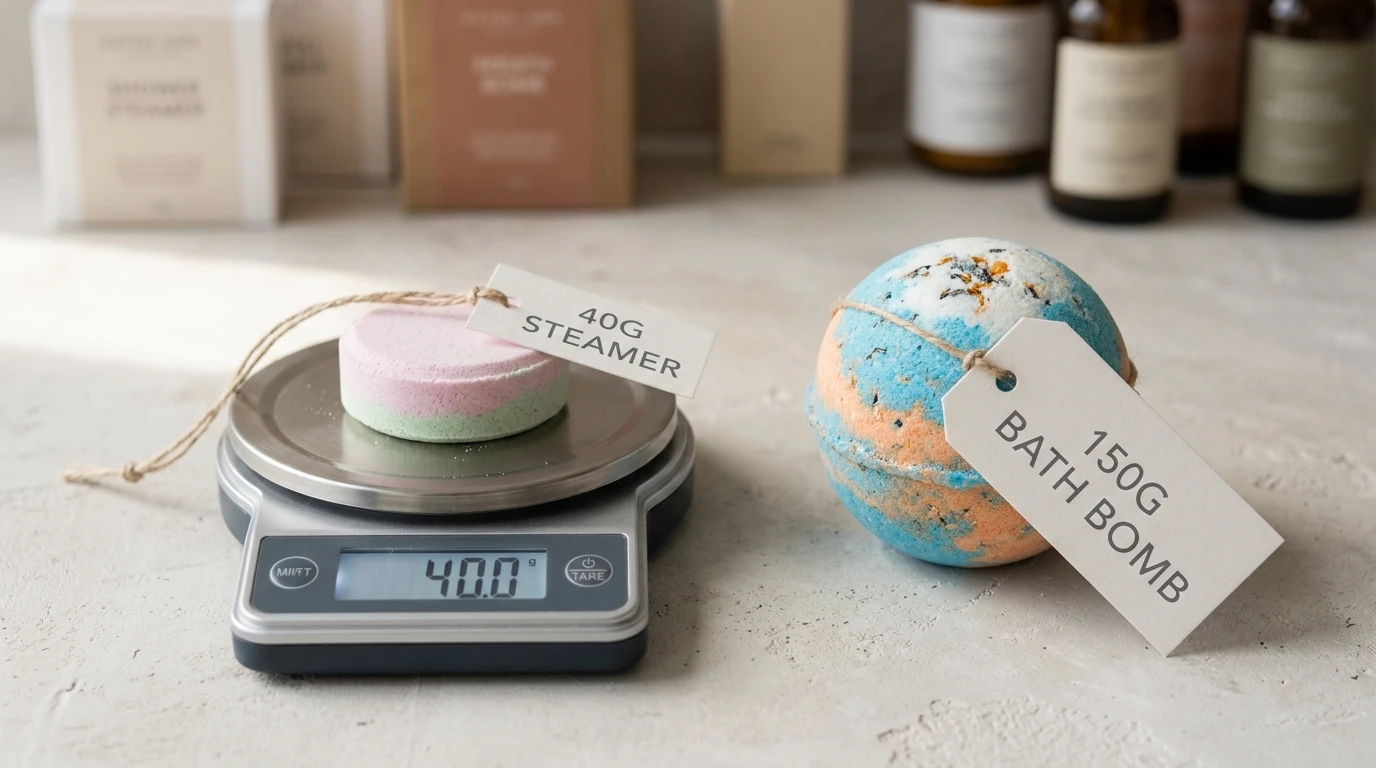
How the formulation actually differs
Bath bombs are built for full submersion. Shower steamers are built for steam contact, which changes the entire formula. We press ours at a lower moisture content and tune the citric acid-to-bicarbonate ratio so the tablet doesn't start fizzing the moment ambient humidity touches it. Essential oil load — typically 2% to 6% by weight — is what the customer actually pays for, and it's the first place a factory will cut if you push hard on price.
That formulation gap has commercial consequences. A well-made 40g steamer retails at $6–9 in the US. A comparable bath bomb struggles to hold $4 because the raw material cost is higher and the shipping weight is brutal.
The margin math, honestly
| Cost Component | Typical Range (bulk, 40g unit) | What Moves It |
|---|---|---|
| Ex-works unit price | $0.28 – $0.65 | EO percentage, wrap, outer box |
| Private label plate / tooling | $150 – $600 one-time | Per scent SKU, not per unit |
| Ocean freight (LCL, per unit) | $0.04 – $0.11 | Packaging density — the dominant variable |
| US duty, HTS 3307.49 | 0% – 2.9% | Verify against the current schedule |
| Landed cost | $0.38 – $0.85 | Before 3PL pick-pack and marketplace fees |
| Indicative retail | $5.99 – $9.99 | Single unit, DTC or shelf |
The spread between the low and high end of that landed cost is almost entirely a design decision, not a negotiation outcome. I'll come back to this.
HS Codes, Duty, and the FDA Question Buyers Get Wrong
Which HS code applies to shower steamers?
Genuine ambiguity exists here, and it costs people real money. Three codes surface in practice:
- 3307.49.0000 — preparations for perfuming or deodorizing rooms. In the US this is the most common and usually correct fit for aromatherapy-positioned steamers, and it carries a low or zero duty rate.
- 3304.99 — cosmetic and skin-care preparations. This is where you land if you market the product as treating skin.
- 3401.30 — organic surface-active products for washing. Almost never correct, but some brokers default to it out of habit.
Classify on intended use and marketing claims, not on what the factory suggests. If your label says "softens skin" or "relieves congestion," you've changed your product's legal category on the same day you approved the artwork.
Does the FDA get involved?
Not "approval" — FDA doesn't approve cosmetics. But registration requirements and prior notice obligations shift depending on the claims you make. This is the filter that separates serious suppliers from the rest:
| Your Claim Position | Regulatory Treatment | What You Need |
|---|---|---|
| Aromatherapy / ambiance only | General merchandise | Standard commercial invoice, no FDA prior notice |
| Moisturizing, skin-softening | Cosmetic | FDA-registered foreign facility, US Agent, ingredient compliance |
| Therapeutic ("relieves congestion") | Drug | Full drug pathway. Not viable for this category |
Read that middle row again, because it's the one buyers walk into. If you want cosmetic-adjacent language, your factory needs an FDA-registered facility and you need a US Agent on file. Plenty of small workshops don't have either. That's a sourcing criterion, not paperwork to sort out later.
EU, UK, and the allergen detail that gets products delisted
In the EU, any cosmetic claim pulls shower steamers under Regulation (EC) No 1223/2009. You need a Responsible Person established in the EU and a Cosmetic Product Safety Report before the product goes on market. The UK runs its own scheme post-Brexit — a UK Responsible Person, separate from your EU one. Don't assume coverage transfers.
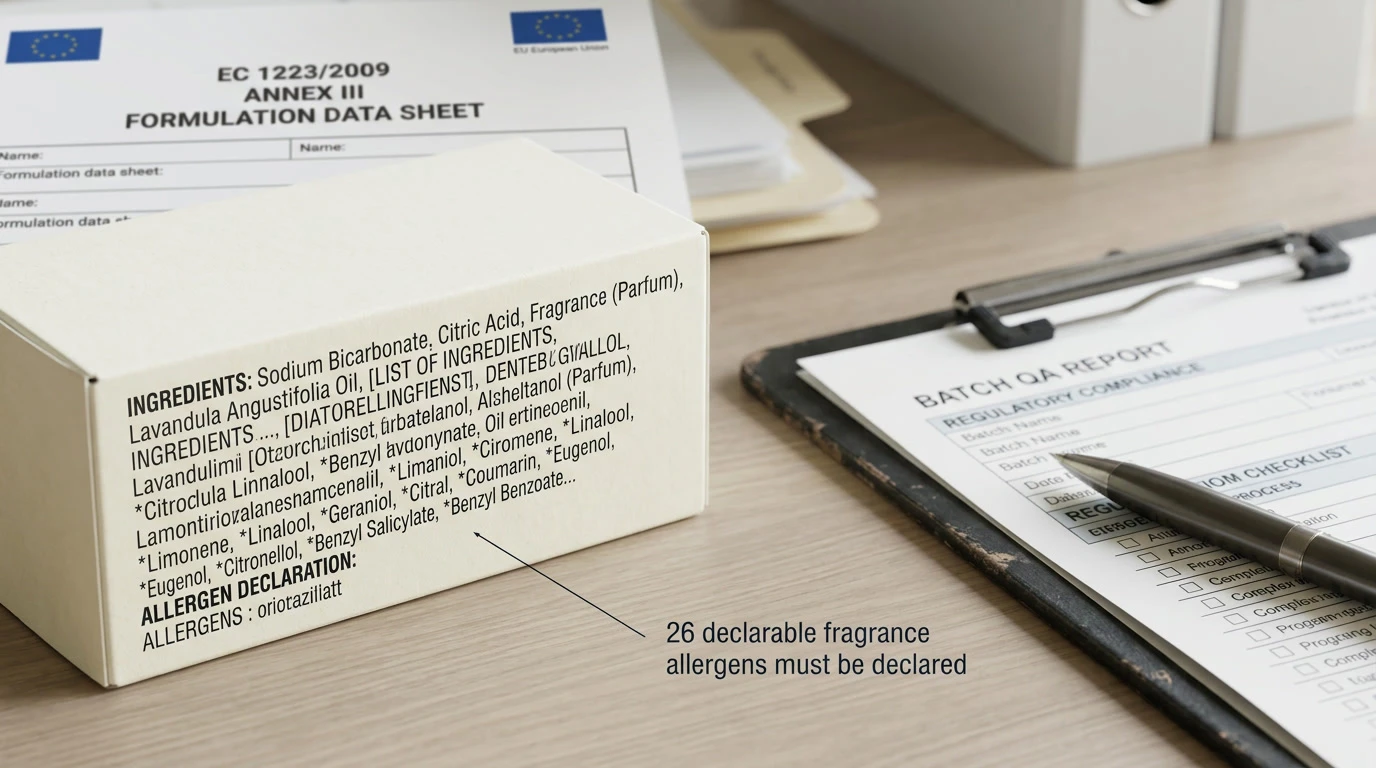
Then there's the allergen question. The 26 declarable fragrance allergens must be listed above 0.001% in rinse-off products and 0.01% in leave-on products. Conservative safety assessors often treat shower steamers as leave-on, since the tablet sits in the shower tray while steam carries the fragrance rather than washing it away. Get that determination from your assessor, not from your supplier's sales rep. Amazon EU marketplaces enforce this aggressively — undeclared allergens are a routine delisting trigger.
How to Vet a Chinese Shower Steamer Supplier
Four questions that reveal whether you're talking to a factory or a trader
I'll save you a few months of email. Send these in your first message:
- "What's your monthly output on our target format?" A real factory answers in units per line or metric tons, and mentions seasonality. A trading company says "large capacity."
- "Can you share your citric acid and sodium bicarbonate supplier invoices?" It sounds confrontational. It isn't. Food-grade input quality is the whole ballgame, and legitimate factories share this readily.
- "Send me video of the pressing line running our shape." Watch tableting pressure consistency and whether the operator is wearing a hairnet. Both tell you something you can't get from a spec sheet.
- "What's your drop-test failure rate?" If nobody knows, they've never shipped at volume or never cared to measure.
MOQ, tooling, and where the flex actually is
| Order Type | Typical MOQ | Tooling / Setup | Lead Time |
|---|---|---|---|
| Stock white-label | 500 – 1,000 units | None | 7 – 15 days |
| Private label, existing mold | 3,000 – 5,000 / scent | $150 – $300 / SKU | 20 – 30 days |
| Custom shape, new mold | 5,000 – 10,000 / scent | $400 – $1,200 / mold | 30 – 45 days |
| Full custom (wrap + box + scent) | 10,000+ / SKU | $800 – $2,000 | 45 – 60 days |
Here's the honest version of MOQ negotiation: if you pay a deposit and signal a reorder timeline, MOQ moves. What does not move is the essential oil load. When a buyer hammers on price, the quiet adjustment is EO percentage — dropped from 4% to 2.5%, invisible on the invoice, and the customer finds out when the steamer smells like nothing. Specify EO load in the PO with an acceptance threshold, and test incoming samples with a scent-throw comparison against the approved golden sample.
Documentation you should refuse to ship without
Every order should carry an MSDS, IFRA certificate, allergen breakdown by scent, certificate of analysis, and FDA facility documentation where applicable. If a supplier hesitates on IFRA for a specific fragrance, that's your answer about whether the fragrance was formulated for this application at all.
Packaging: Where Landed Cost Is Decided
Format drives freight more than anything else
| Packaging Format | Units per CBM | Freight / unit (approx.) | Damage Risk | Best Fit |
|---|---|---|---|---|
| Bulk in poly bag | ~2,800 | $0.03 | High | Refill / multi-pack |
| Shrink-wrapped single | ~1,400 | $0.06 | Medium | Individual SKU |
| Flow-wrap plus label | ~1,100 | $0.08 | Low | Retail-ready |
| Individually boxed | ~600 | $0.14 | Very low | Premium / gifting |
The boxed format runs roughly four to five times the per-unit freight of bulk. It's frequently worth it — gift sets hold price better than singles — but make it a deliberate choice rather than a default someone checked on a form.
The humidity problem nobody flags early enough
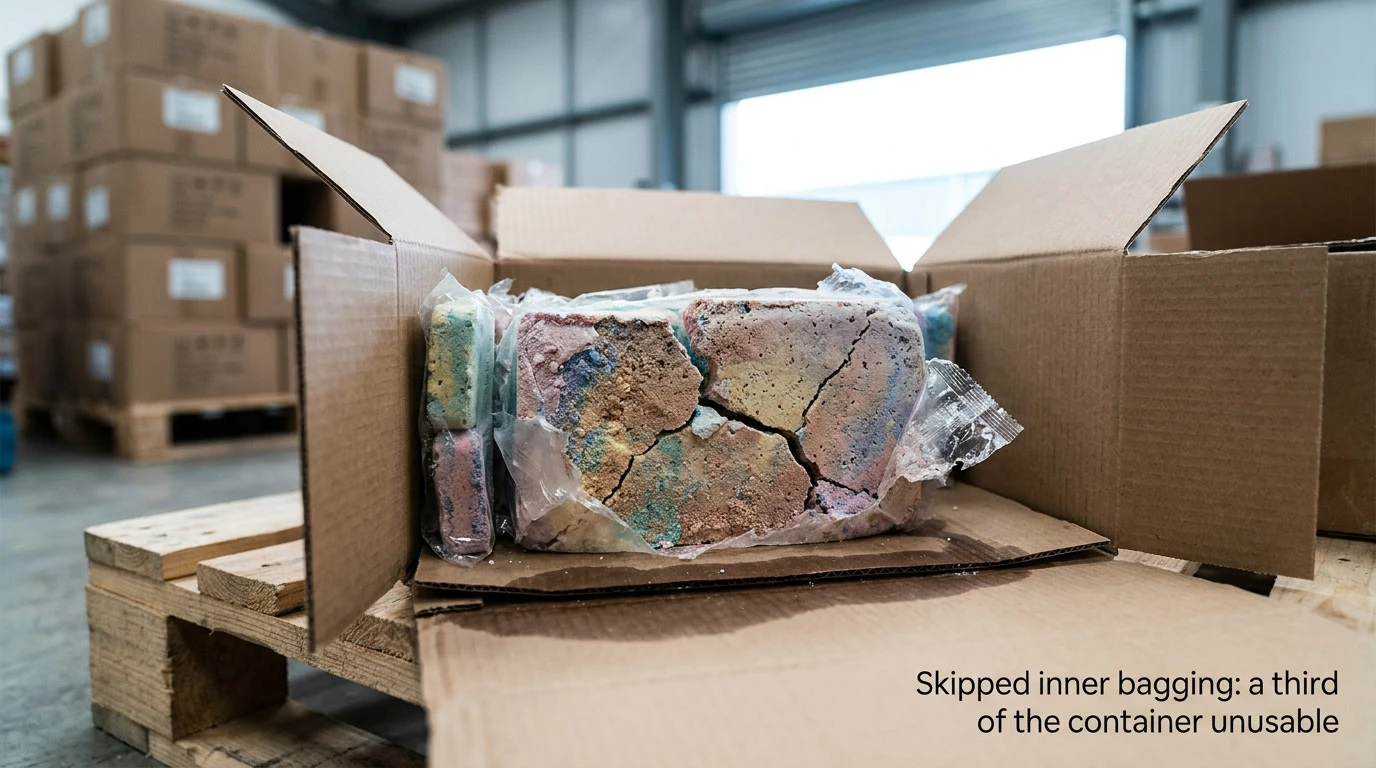
Shower steamers absorb moisture. Ship them in a wet month with inadequate inner bagging and you'll open cartons to find them fused into bricks. To prevent it: individual flow-wrap with a moisture barrier, master carton lined with a PE bag plus desiccant, and production scheduled away from peak humidity. Guangdong and Zhejiang summers are unforgiving on this line.
We've seen a 20-foot container arrive with roughly a third of its units unusable because the factory skipped inner bagging to save two cents a unit. That's not a saving. That's a write-off with extra freight attached.
Common Importing Mistakes Worth Avoiding
Letting the factory pick your HS code
They'll choose whatever clears fastest, not what's defensible. Have a licensed customs broker confirm classification against your final packaging copy — before production, not before sailing.
Skipping pre-shipment inspection
Above roughly $5,000 order value, a third-party inspection at $300–$500 is cheap insurance. Have them check weight variance, scent throw, drop test results, and label accuracy against your approved artwork.
Treating "FDA compliant" as a meaningful phrase
It's marketing language. Ask directly: is the manufacturing facility registered with FDA, what's the registration number, and who is your US Agent? Then verify independently rather than accepting a PDF.
Single-sourcing a seasonal SKU
Q4 demand crushes smaller factories, and you'll hear about it as a delay, not a refusal. If shower steamers are your holiday item, place orders by August and qualify a backup supplier. Nobody enjoys learning this in November.
How We Handle This
We've been manufacturing personal care products since 1995 — 40,000 square meters of factory, sixteen automated production lines, GMP, ISO, FDA, and SMETA certified. That matters less as a credential list than as a working reality: when you ask about citric acid grade or pressing pressure, you're talking to the people standing on the line.
In practice, that means a few things other suppliers won't do. We'll tell you when your packaging copy is about to move you into a stricter regulatory category, before you print 50,000 boxes. We ship a full documentation package with every order — MSDS, IFRA certificates, allergen declarations, COA, and FDA facility documentation where it applies. We run custom samples in 7–14 days depending on formula, fragrance, and packaging complexity, and we schedule humid-season production with the moisture risk in mind instead of pretending it doesn't exist.
MOQ starts at 1,000 units, and we're realistic about first orders — we'd rather start a buyer at a testable volume and grow into container loads than scare them off with a number. Vegan formulations and cruelty-free certification are standard options, not upsells.
If you're evaluating shower steamer suppliers in China and want a straight answer on feasibility, MOQ, or compliance for your market, send us your product brief. You'll get a realistic assessment, including the parts you won't enjoy hearing. That's the point of talking to a factory rather than a broker.
The Bottom Line
Importing shower steamers from China is a sound business. Margins are real, the manufacturing base is mature, and the category still has room. What it punishes is treating the product as a commodity buy.
The importers who do well get three things right: classification that matches their actual claims, verified facility compliance with documentation you can hand to a broker or a marketplace, and moisture-controlled packaging specified up front. Everything after that is commercial negotiation, and negotiating from a position where those three are already locked is a very different conversation.
Get those settled before you place a PO, and you're already ahead of most of the people bidding against you.
FAQ
Q: How much does it cost to import shower steamers from China?
A: Landed cost for a standard 40g unit typically runs $0.38–$0.85, depending on essential oil load, packaging format, and order size. Bulk packaging at container volume pushes toward the low end; individually boxed premium private label sits at the top. Freight is often the swing factor, and it's driven by packaging density more than by freight rates.
Q: What is the MOQ for private label shower steamers?
A: Most manufacturers ask for 3,000–5,000 units per scent on private label. Stock white-label runs can start near 1,000 units. MOQs are more flexible on first orders than the published numbers suggest, particularly when you commit to a reorder window.
Q: Do I need FDA approval to import shower steamers?
A: There's no such thing as FDA approval for cosmetics. What matters is registration and claims alignment. If you make cosmetic claims, the foreign manufacturing facility must be FDA-registered and you need a US Agent on file. Aromatherapy and ambiance claims generally keep the product in general-merchandise territory. Your HS classification and your marketing copy need to tell the same story.
Q: What HS code do shower steamers use?
A: HTS 3307.49.0000 is the most common and usually correct code for aromatherapy shower steamers in the US, and it generally carries a low or zero duty rate. Confirm with a licensed customs broker using your final printed packaging, since claims language can shift the classification.
Q: How long does shipping from China take?
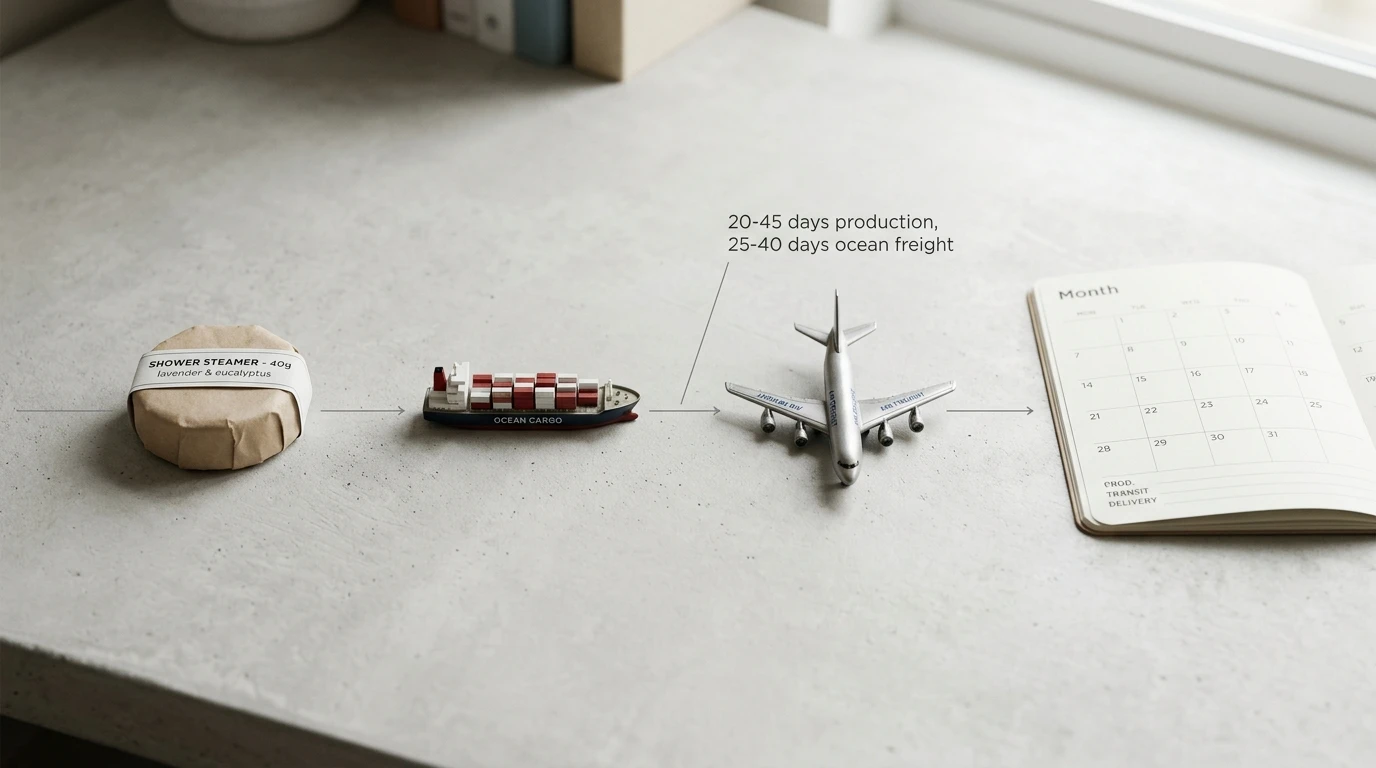
A: Production runs 20–45 days depending on customization depth. Ocean freight adds 25–40 days to US ports and 30–45 days to the EU. Air freight takes 5–8 days but is rarely economic here, because unit value is low relative to weight.
Q: Can shower steamers melt or degrade in transit?
A: They won't melt, but they will absorb moisture and fuse. Specify individual flow-wrap with a moisture barrier and desiccant-lined master cartons in the PO, and avoid shipping during peak humidity months where scheduling allows.
Q: Are essential oils the biggest cost driver?
A: By percentage, yes. EO load typically runs 2%–6% of tablet weight, and the difference between a 2.5% and a 5% formulation is felt directly in unit price and in scent throw. It's also the first spec quietly reduced when a buyer pushes too hard on price, so put a minimum EO percentage in writing.