
How to vet wholesale jewelry bath bomb suppliers: MOQs, toy compliance, capsule QC, private label costs, and bulk ring-inside pricing.
You've got a purchase order drafted, a retail buyer waiting on samples, and a supplier who keeps answering your compliance questions with "yes, no problem" — but never with a document. That gap is where most jewelry bath bomb programs die, usually three weeks before a container is supposed to sail.
I run production at Boymay, a personal care factory in GuangDong that's been filling bath and body lines since 1995. We've quoted against, lost to, and occasionally partnered with nearly every name in this niche. What follows is how I'd actually evaluate this supplier pool if I were sitting on your side of the table.
Key Takeaways
- Jewelry bath bombs are legally two products in one retail unit — a cosmetic body and a toy capsule — and the toy side is what sinks most US and EU shipments.
- The category splits into true OEM factories, component/prize specialists, and Western contract fillers. Choosing the wrong model for your volume is the #1 sourcing error.
- Capsule assembly is largely hand-fed, which is why MOQs here run 5,000–10,000 for stock molds and 20,000+ for custom ring tooling — higher than standard bath bombs.
- Realistic pricing: roughly $0.85–$2.40 FOB for a 150g ring bomb, depending on prize value and packaging.
- The ten companies below are ranked by fit-for-purpose, not headcount. A 600-employee fragrance house is often the wrong answer for a 30,000-unit seasonal gift set.
Why a Jewelry Bath Bomb Is a Different Category Than You Think
Two compliance regimes inside one SKU
The effervescent ball is a cosmetic under EU Regulation 1223/2009 and most US state interpretations. The capsule and the prize inside are classified as children's toys if the packaging or marketing targets anyone under 14 — which most gift-set packaging does. That single decision pulls the whole SKU into EN 71-1/2/3, ASTM F963, CPSIA lead and phthalate limits, and a Children's Product Certificate for US import.
In twelve years of running filling lines, the failures I've watched weren't cosmetic failures. They were toy failures: a ring alloy testing at 400 ppm lead, a capsule that failed a tension test and released the prize under a simulated mouth scenario, a decorative charm glued to the outer wrap that nobody tested because nobody noticed it was there.

Why buyer interest is still climbing
The broader bath bomb gifting wave cooled hard after 2020. The jewelry sub-segment didn't, because the perceived value anchors to the prize, not the fizz. Retailers in this segment consistently report ring-in-bomb SKUs turning two to three times faster per facing than plain bombs during gift resets, and collectible ring lines pull repeat purchase rates well above baseline bath. That margin structure is why private label inquiries in this niche have grown faster than the category around it.
What Actually Separates a Good Factory From a Mediocre One
Capsule engineering, not fragrance
Anybody with a hydraulic press can pack a bath bomb. The delivery mechanism is where the money is. Before you talk price with any jewelry bath bomb manufacturer, get answers to three questions in writing:
- What is your capsule wall thickness tolerance, and how do you verify seal integrity per batch?
- Does the capsule dissolve before, during, or after the outer ball?
- Can you provide the toy test report for the specific ring SKU I'm buying — not a blanket certificate for "metal alloy"?
Factories that answer all three with dated documents are the top tier. Factories that answer with enthusiasm and no paperwork are the ones that will cost you a container and a retail relationship.
Dissolution timing is a brand promise
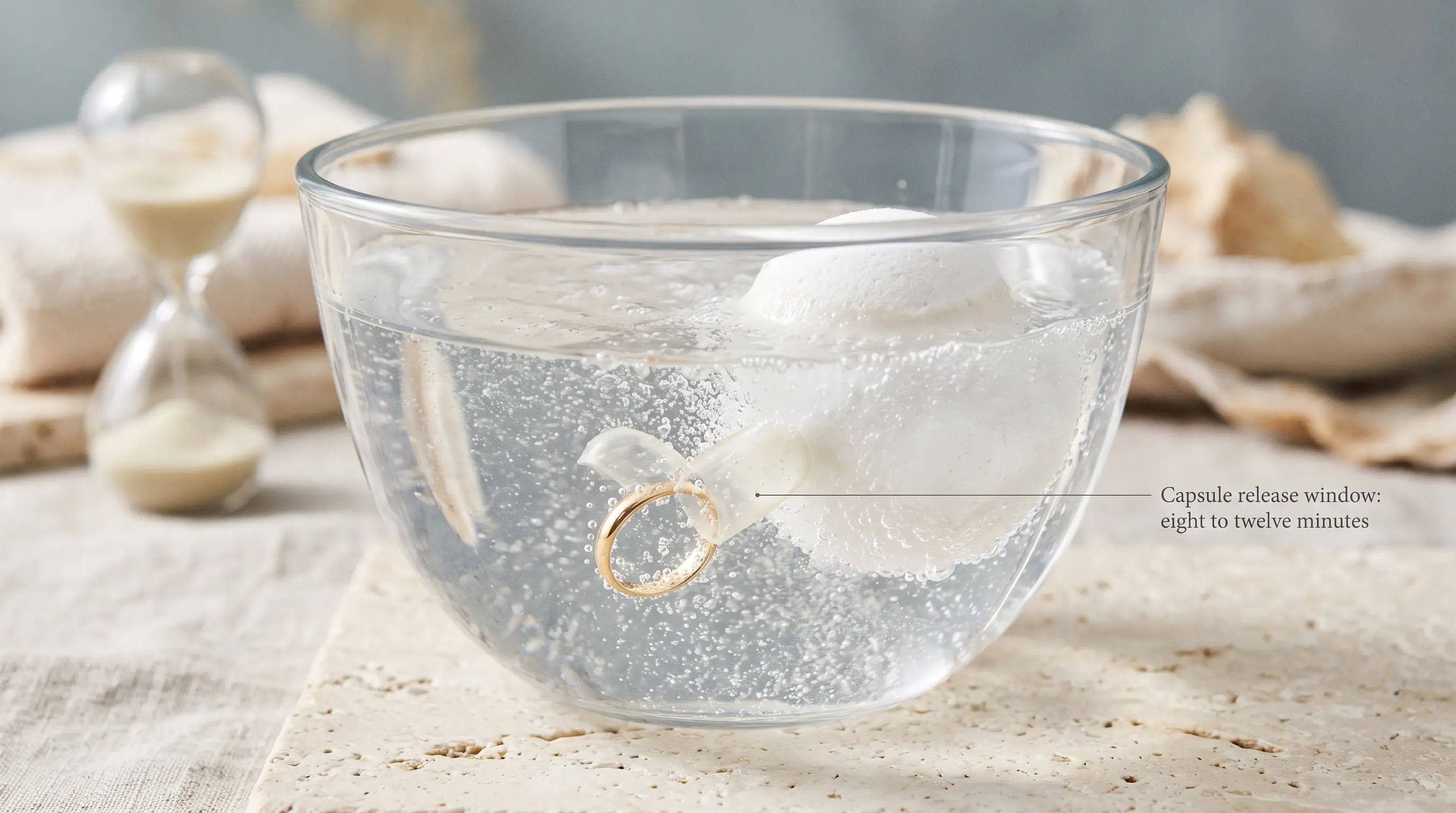
When the prize appears defines the entire customer experience. A capsule that surfaces in thirty seconds kills the ritual. One that takes twelve minutes and consumers are already out of the tub. The window most of our clients settle into is three to five minutes of visible fizz, then the capsule floats free. That's a mold geometry and density call made at tooling stage — it cannot be corrected in QC after the fact.
Colorant and fragrance load
Cosmetic-grade colorants need batch certification (EU Annex IV; FDA 21 CFR Part 73/74 in the US). Water-soluble dyes will stain acrylic tubs and generate returns you can't argue your way out of. Reputable houses run FD&C-approved lakes or mica pigments at roughly 0.3–0.8% load. Push past 1.2% and you're manufacturing complaints. Fragrance sits around 1.5–3% for a 150g ball; overloading it softens the matrix and the bomb crumbles in transit.
The Ten Manufacturers, Grouped by What They're Actually Good At
Tier 1 — Full-service OEM and private label houses with in-house capsule assembly
| # | Company | Base | Core Strength | Typical MOQ | Best For |
|---|---|---|---|---|---|
| 1 | Boymay (Zhejiang) | Guangdong, Huizhou | 40,000 m² facility, 16 automated lines, GMP/ISO/FDA/SMETA, in-house capsule assembly and toy dossiers | 1,000 pcs | Mid-size private label programs needing low MOQ plus full certification |
| 2 | Yiwu Sunny Cosmetic Co., Ltd. | Yiwu, Zhejiang | Ring and toy capsule tooling in-house; 14 press lines | 5,000 pcs | Startups and fast iteration |
| 3 | Ningbo Lisi Daily Chemical | Ningbo, Zhejiang | Fragrance depth (600+ accords), EU cosmetic notification support | 10,000 pcs | Premium retail, EU market |
| 4 | Guangzhou Aoyin Biotechnology | Guangzhou, Guangdong | Toy-certified capsules, CPSIA/EN 71 dossiers ready to ship | 8,000 pcs | US big-box and Amazon sellers |
| 5 | Foshan Nanhai Meiyi Craft | Foshan, Guangdong | Gift-set assembly, rigid box co-packing | 3,000 sets | Holiday gift programs |
| 6 | Hangzhou Kaiyuan Aromatics | Hangzhou, Zhejiang | High-volume automation, ~55,000 pcs/day capacity | 20,000 pcs | Mass-market volume runs |
Boymay sits at the top of this tier for one reason worth stating plainly: we run a 1,000-piece MOQ against a certified, audited line. Most factories offering that MOQ are trading on flexibility, not documentation. Buyers who need both — a modest opening order and CPSIA-ready paperwork — usually end up here.
Tier 2 — Specialist capsule and prize suppliers (component partners)
| # | Company | Base | Core Strength | Typical MOQ | Best For |
|---|---|---|---|---|---|
| 7 | Dongguan Hongyuan Plastic Capsule | Dongguan, Guangdong | Food-grade PP/PLA capsules, custom geometry | 50,000 caps | Building your own assembly line |
| 8 | Shenzhen Ruihe Metals | Shenzhen, Guangdong | Nickel-free brass and stainless prize rings | 10,000 pcs | Jewelry brands co-branding a bomb |
| 9 | Shantou Chenghai Toy Capsule Works | Shantou, Guangdong | Certified toy prizes (non-jewelry), licensed character systems | 30,000 pcs | Novelty and licensing programs |
Tier 3 — Western-facing contract fillers
| # | Company | Base | Core Strength | Typical MOQ | Best For |
|---|---|---|---|---|---|
| 10 | Yorkshire Bath Co. (contract division) | Leeds, United Kingdom | UK/EU cosmetic notification held, SEDEX audited | 2,500 pcs | UK indie retail, small premium runs |
| 10 | Salt & Fizz Labs | Portland, Oregon, USA | Domestic fill, FDA-registered facility, ~10-day turnaround | 1,000 pcs | US DTC brands needing speed |
Deep Dive: What Each Tier Means for Your P&L
Tier 1 economics
A 150g ring bomb from a Zhejiang or Guangdong factory prices at roughly $0.85–$1.30 FOB with a base-metal prize, or $1.60–$2.40 with a rhodium-finish or plated band. Add a printed rigid gift box and you're at $2.00–$3.10 FOB, landing around $3.80–$5.50 wholesale. Ocean freight to a US East Coast port adds $0.18–$0.35 per unit at LCL volumes, dropping toward $0.09–$0.14 on a full 40HQ.
Tier 2 economics — the self-assembly model
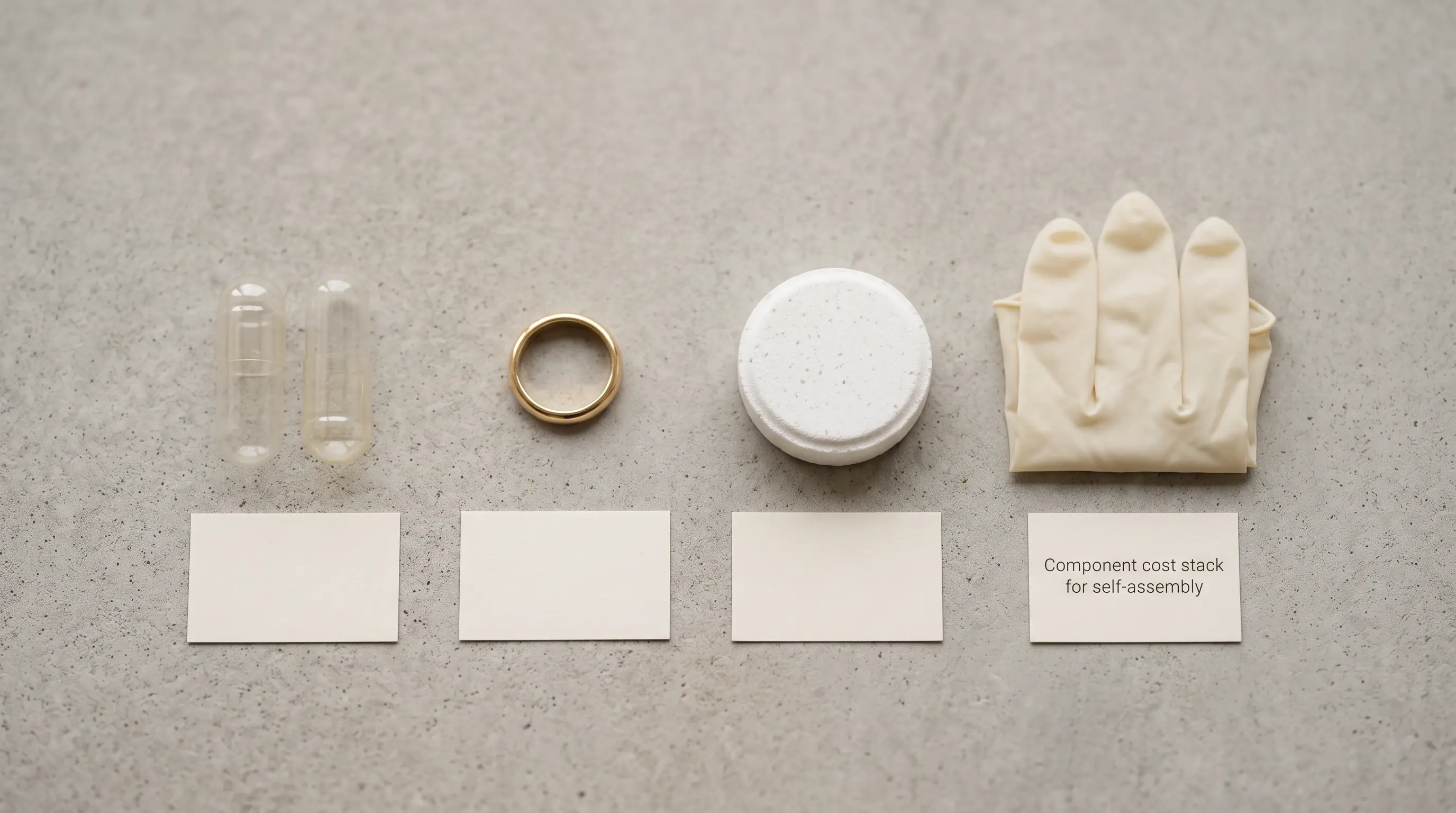
Buying components and assembling domestically almost never saves money below 50,000 units. Rough math: capsule $0.08–$0.14, ring $0.35–$1.80 depending on metal, bomb body $0.30–$0.55, labor $0.25–$0.40. You break even against Tier 1 around 40,000 units — and you inherit the entire compliance burden. Where this model wins is control. If your brand promise is a specific, exclusive prize, owning the capsule and the ring is how you guarantee it.
Tier 3 economics
UK and US domestic fill runs three to five times the FOB cost of Chinese production. You're buying speed, duty avoidance, and audit-friendliness rather than unit cost. For a US brand launching a direct-to-consumer line with a four-week lead time requirement, that premium is frequently worth it — but it rarely survives a mass retail margin sheet.
Pros & Cons: Sourcing Jewelry Bath Bombs From China vs. Domestic
| Factor | Chinese OEM (Tier 1/2) | US/UK Contract Filler (Tier 3) |
|---|---|---|
| Unit cost (150g ring bomb) | $0.85–$2.40 FOB | $3.10–$5.80 ex-works |
| MOQ | 1,000–20,000 pcs depending on factory | 1,000–2,500 pcs |
| Lead time | 25–45 days production + 30–45 days freight | 7–15 days |
| Tooling flexibility | Excellent — new molds in 10–18 days | Limited to existing molds |
| Toy compliance burden | On you, unless the factory supplies dossiers | Often handled by the filler |
| Duty and tariff exposure | Yes, plus Section 301 tariffs on some HS codes | None or minimal |
| Cost if something goes wrong | Container-level loss | Batch-level loss |
| Best when | Volume ≥ 10k and margin is tight | Speed and small-run market validation |
Common Mistakes I Watch Buyers Repeat Every Season
- Accepting a generic toy certificate. A factory's EN 71 report for "plastic capsule, generic" does not cover your ring's nickel release or your charm's lead content. Every distinct prize SKU needs its own line item in the dossier.
- Skipping your own stain test. Run 40°C water in a white acrylic basin. We've seen three "cosmetic-compliant" reds that left a pink ring after every bath.
- Ignoring moisture migration. A ring bomb sitting three weeks in a humid warehouse absorbs ambient moisture, softens, and fuses to its inner wrap. Specify a desiccant sachet in the master carton plus a moisture-barrier inner bag. It costs cents and almost nobody does it.
- Under-budgeting the prize. Prize quality drives return rate and review scores harder than the fizz ever will. A ring that tarnishes after two wears generates more one-star reviews than a weak scent.
- Assuming one factory does everything. The best capsule houses are not the best fragrance houses. Splitting capsule and body across two suppliers and assembling at a third is standard practice at scale.
How to Vet a Supplier in Seven Steps
- Request the toy dossier before the price list. If documents stall, they don't exist.
- Order a 50-piece trial with the exact ring SKU you intend to sell — not a sample-room hero item.
- Test dissolution at 38°C and 42°C. The prize should release between three and five minutes.
- Run a nickel-release spot test on any metal worn against skin (EN 1811 / EN 12472 reference methods).
- Ask for the last two factory audit reports — BSCI, SEDEX/SMETA, or equivalent.
- Confirm carton-level humidity protection in writing — desiccant plus barrier bag.
- Place a 5,000-unit pilot before the seasonal commit. Never open with your full holiday PO.
Working With a Factory That Actually Understands This Category
Here's the honest part. I work at Boymay — the name at the top of that Tier 1 table — and we've been doing OEM and ODM personal care since 1995, long before jewelry bath bombs were a category anyone asked about. We built the capsule line because too many buyers kept getting burned by suppliers who treated the prize as an afterthought.
What we bring: a 40,000 m² facility, 16 automated production lines, 200-plus staff, and GMP, ISO, FDA, and SMETA certification held on-site rather than promised for "next quarter." Our MOQ starts at 1,000 pieces. Custom samples typically go out in 7–14 days depending on formula, fragrance, appearance, and packaging, and bulk production runs 25–30 days. Formulas can be built vegan and we don't test on animals.
If you're scoping a holiday program, the calendar matters more than the quote. Capacity books up fast from late spring onward, and lead times stretch once the seasonal queue fills. Send us your prize concept, target retail price, and destination market, and we'll come back with a costed proposal plus the relevant test reports. And if your volume or timeline fits another factory on this list better, I'll tell you that too — a wasted container helps nobody.
FAQ
Q: What's a realistic MOQ for a custom ring bath bomb?
A: Expect 5,000–10,000 units if you're using an existing capsule mold and a stock ring. A fully custom prize — your logo struck on the band, a bespoke stone — typically pushes MOQ to 20,000–30,000 because the ring tooling carries its own setup cost. Some certified factories, including our own line, open as low as 1,000 pieces on stock molds.
Q: How much does a private label jewelry bath bomb cost per unit?
A: At 10,000 units with a base-metal prize, $0.95–$1.40 FOB is typical. Premium packaging and a plated ring push that to $2.00–$3.20 FOB. Domestic US fill runs $3.10–$5.80 ex-works.
Q: Do jewelry bath bombs require toy safety testing?
A: If the product is marketed to anyone under 14 — and most gift-set packaging is — yes. In the US you need CPSIA-compliant testing and a Children's Product Certificate; in the EU, EN 71 compliance plus a toy technical file. Marketing the same SKU strictly as adult gifting shifts the regime legally, but Amazon and most national retailers apply the stricter standard regardless.
Q: Can I put a real gemstone or precious metal ring inside?
A: Yes, and it's the fastest route to a premium price point. The trade-off is MOQ and lead time — a supplier sourcing certified stones adds three to six weeks and will typically want a materials deposit before production starts.
Q: What's the most common reason these shipments get held at customs?
A: Missing or mismatched toy test documentation for the prize, followed closely by inaccurate HS classification. Bath preparation usually falls under 3307.90; the toy component may fall under Chapter 95. Misclassify and you're looking at a hold plus back duty.
Q: How long does a jewelry bath bomb stay shelf-stable?
A: 18–24 months with proper moisture control. Without a desiccant and barrier bag, expect visible softening and wrap fusion within 8–10 weeks in a humid warehouse.